Chegg Which of the Following Is True About Restriction Endonucelases
They are non-specific and cut anywhere along a sequence. The abbreviation R represents the purines adenine and guanine.
Solved Which Of The Following Is Not True Of Restriction Chegg Com
They make staggered cuts on the DNA so that single-strand ends are formed that can be used to insert foreign DNA cut with the same enzyme C.
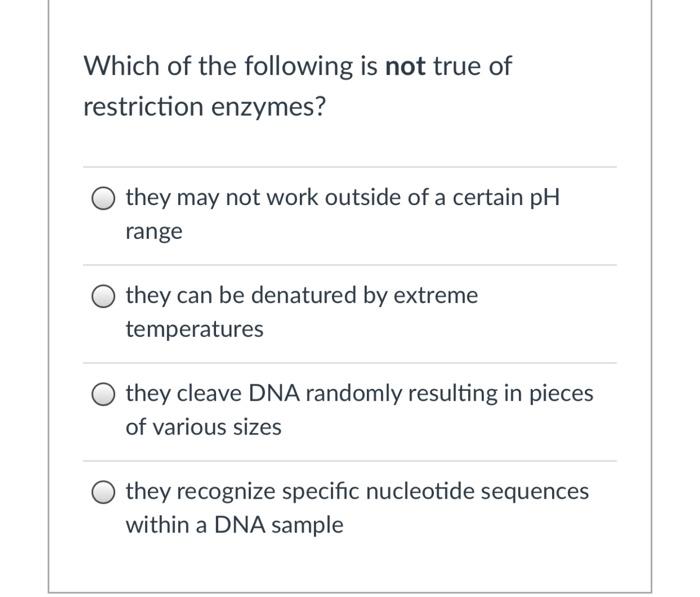
. A T C or G. They are used by bacteria to cut up foreign DNA. A restriction enzyme are used to cut DNA molecule.
Cleavage sites for a particular RE are regularly spaced along a DNA molecule separated by an interval characteristic of the particular RE. Which of the following is true about restriction endonucleases. Thus both Type I and III are not used in genetic engineering.
Asked Mar 13 2018 in Class XII Biology by rahul152 Expert 84k points Which of the following is not a source of restriction endonuclease. A Restriction Endonucleases These are the bacterial enzymes that cut dsDNA into fragments after recognising and binding to the specific nucleotide sequences known as recognition site. BThey allow bacteria to genetically recombine with other bacteria.
Which of the following statements is NOT true for southern blot. Restrictions enzymes are one class of the broader endonuclease group of enzymes. The symbol R means.
The probes are double-stranded small stretches of nucleic acid with a known sequence. A they can cut DNA at specific sequences. B Gel-Electrophoresis is the technique which allows the visualisation of.
B restriction enzyme are used to construct restriction maps. Which of the following is NOT true of Restriction Endonucleases. The use of microorganisms or their products to alleviate plant disease is.
40 Which of the following statements is are correct about restriction enzymes. Restriction endonucleases nick one strand of the DNA helix generating nicked fragments that can be separated by electrophoresis. C They allow bacteria to engineer new DNA fragments.
This answer is incorrect. The following table shows where different restriction endonucleases restriction enzymes cleave DNA. A They are enzymes that are present in prokaryotes b They catalyze the hydrolysis of phosphodiester linkages at specific points within the nucleotide base sequence of the DNA strands c Both a and b are correct d They are not present in prokaryotes e They have no tertiary.
Restriction enzymes are commonly classified into five types which differ in their structure and whether they cut their. A restriction endonuclease breaks bonds between the. Which of the following is true about electrophoresis.
Learn vocabulary terms and more with flashcards games and other study tools. What is the function of restriction endonucleases in bacteria. This answer is incorrect.
They are involved with heterochromatin production. 1 Which of the following statements about restriction endonucleases is correct. This answer is incorrect.
B they all make 5 phosphate extensions and recessed 3 OH groups that can be rejoined by DNA ligase. Restriction sites in an organism whose DNA has a random sequence and equal. Everse mutations involve changing a wild-type allele to a mutant alleleTerm.
For the following restriction endonucleases calculate the average distance between. While Type II restriction enzymes are highly useful in recombinant DNA techniques because they have a separate specific enzyme for restriction which. This answer is correct.
Option 3 DNase I. They all make cohesive ends when they cut DNA. 5 points Which of the following is TRUE of the reaction catalyzed by restriction endonucleases.
They make a blunt cut on the two DNA strands so that there are no single-strand regions B. Start studying Restriction endonucleases. A restriction enzyme or restriction endonuclease is an enzyme that cleaves DNA into fragments at or near specific recognition sites within the molecule known as restriction sites.
Hind II are restriction endonuclease because they cleave DNA at specific sequence within DNA strand. Restriction endonucleases are useful in gene cloning because. C restriction enzyme are used in RFLP.
These enzymes are used to form recombinant molecules of DNA composed of DNA from different sources. The pyrimidines cytosine thymine and uracil are abbreviated as Y. 7Which of the following are true regarding restriction enzyme.
The reaction produces DNA strands with a free 3-hydroxyl group and a 5-phosphoryl group In addition to water the metal in carbonic anhydrase is coordinated to. A _____ is a change in a single base pair within the DNA. Any purine A or G Y means any pyrimidine T or C and N stands for any nucleotide.
In a plasmid vector the number of sites for a restriction endonuclease is present. Which of the following statements is NOT true about restriction endonucleases. 1st Restriction enzyme Hind II was used in RDT.
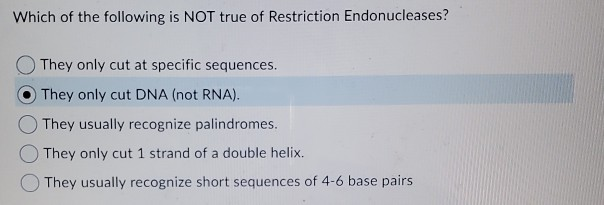
They usually recognize palindromes. C both a and b. A They serve no function.
They only cut DNA not RNA. C they can join DNA molecules that have been D cut at specific sequences. Option 1 Hind II.
They only cut at specific sequences. Proportions of all four nucleotides 25 each of A T C and G. All of the answers are correct.
All of the above. Name the first restriction endonuclease. DThey provide a defense mechanism against infection by viruses.
They usually recognize short sequences of 4-6 base pairs. Type III restriction systems have separate enzymes for restriction activity and methylation and cleave outside the restriction site. They only cut 1 strand of a double helix.
They cut DNA unevenly to produce sticky ends III.
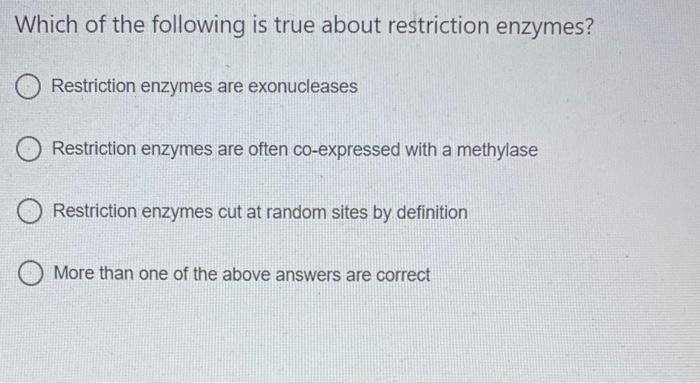
Solved Which Of The Following Is True About Restriction Chegg Com
Solved Which Of The Following Is Not True Of Restriction Chegg Com
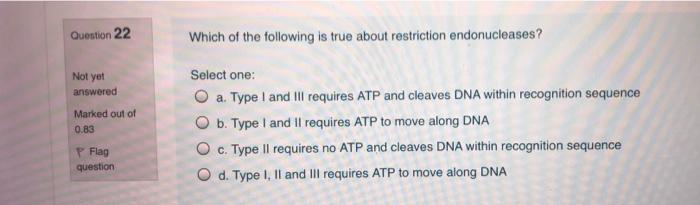
Solved Question 22 Which Of The Following Is True About Chegg Com


Comments
Post a Comment